

Even if your assignment is amazing overall, poor structuring will result in a mark deduction. The tutor would have difficulty understanding your argument, reviewing the evidence you have provided, and judging if you have followed the task correctly. A good structure makes all of this easier for the tutor.
This guide explains the assignment structure format used across UK higher education. It includes a detailed discussion on how to plan, set up pages, organise paragraphs, reference, proofread, and submit an assignment in accordance with the structure format.
The guide is ideal for students who are undertaking any form of coursework at a UK university. After reading this guide, you will know everything about the significance of structure in academic writing.
| Quick summary: A good assignment structure format for students includes a title page, table of contents (if necessary), introduction, main body, conclusion, references and appendices. Always keep in mind the instructions provided by your college or university. |
What does an assignment structure format mean?
The assignment writing structure refers to how the ideas are organised. For example, an essay starts with an introduction and follows with a series of arguments culminating in a conclusion. A report has different sections such as results, discussion, and recommendations.
The format of assignment writing covers presentation. In other words, it covers elements such as font, spacing, headings, margins, figures, tables, quotations, citations, and references.
These two parts work together. Useful research can still lose impact when its order is unclear or formatting rules are ignored.
Your coursework brief usually gives the first set of instructions. It may explain the task type, word count, deadline, required sources, and submission method. It may also refer to assessment criteria and learning outcomes. These show what your tutor expects you to demonstrate.
An effective academic assignment structure helps the reader answer four questions:
- What is the purpose of the work?
- What claim or question is being explored?
- What evidence supports each point?
- What answer has the writer reached?
Why Correct Structure Matter at UK Universities?
Adhering to the standard assignment format UK can enhance the clarity of presentation as well as the quality of the writing. Tutors often assess content and presentation together. A well-organised paper allows them to see your knowledge without searching through confusing sections.
Clear structure also helps you address the marking rubric. An assessment rubric is a document which details how marks are allocated in various aspects, such as knowledge, argument, evidence, analysis, organisation, and referencing.
Correct formatting creates a professional appearance and shows that you followed the instructions. It also helps your module tutor give useful tutor feedback. Structure supports academic honesty too. In-text citations and a reference list are used to indicate sources of information used. This reduces the risk of plagiarism.
Do not assume every institution follows one fixed university assignment format. Therefore, make sure that you understand the requirements of your module handbook, student handbook, and task instructions before writing.
Step #1 – Understand the Assignment Brief
Prior to making decisions about how to structure assignment work, it is wise to read the brief several times over. Sometimes, reading through a brief quickly can mean important information is overlooked.
The first thing you need to do is to determine the nature of your assignment. Is it an essay, report, reflective piece, case study, literature review or something else? Different types have different purposes and may require different sequences.
Next, highlight the command words. Some common verbs include analyse, compare, discuss, evaluate, explain, and reflect. These verbs will give you clues as to how to answer the question. Analysis means dividing the question into parts, while evaluation means judging the value of something.
Check the assessment brief for:
- Required learning outcomes
- Word count and permitted variation
- Required headings or sections
- Number and type of sources
- Referencing style, such as the Harvard referencing
- File type and naming rules
- Deadline and submission time
- Similarity checking through Turnitin
Read the marking criteria beside the brief. This helps you see which areas carry the most marks. It also gives you a practical answer to how to structure a university assignment around the tutor’s priorities.
Before we get to structure, it is helpful to understand the entire assignment writing process. In our guide to writing an assignment we explain every stage of producing a high quality university assignment – from analysing the brief and doing research to writing, editing and submitting.
Step #2 – Plan Before You Start Writing
Before creating your outline, it helps to understand how to plan an assignment so you can organise your research, manage your time, and structure your ideas effectively Start off by drawing an easy mind map. First, place your topic in the centre, then all the relevant questions, theories, and debates surrounding it.
Begin with your reading list; look through your university’s library database to find books, reports, and journal articles. Do not include additional material just because it seems interesting but does not answer the question posed.
Classify your notes into themes. Each theme may form a section or a paragraph. Eliminate any information that is irrelevant to the task.
Prepare an initial outline with projected word counts. For a 2,000-word essay, this should be something like:
| Section | Suggested words |
| Introduction | 200 |
| Main body section 1 | 500 |
| Main body section 2 | 500 |
| Main body section 3 | 500 |
| Conclusion | 300 |
This is only a guide. Your brief and marking criteria should decide the final balance.
Set deadlines for the different stages of researching, planning, writing, referencing, and reviewing. Give yourself time between drafting and reviewing to see gaps in your evidence and reasoning.
A practical plan should show what each section will do, not only what topic it will mention. This strengthens the assignment writing structure and improves the structure of an assignment before writing begins.
Step #3 – Build the Assignment Layout
The assignment layout is the full order of pages and sections. Adapt this model to your brief.
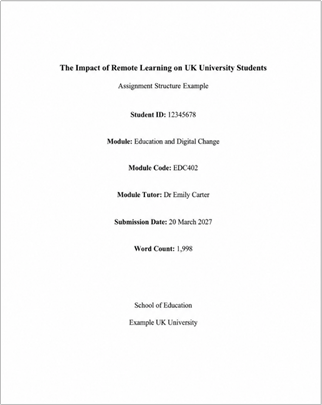
Front Page
The front-page format of assignment work normally includes the following:
- Assignment title
- Student name when allowed
- Student ID
- Module title and code
- Lecturer or module tutor name when requested
- Submission date
- Word count
- University name
For anonymous marking, please include only your student ID number and not your name.
Use a plain page format. No need to have fancy graphics, logos, or coloured backgrounds unless specifically stated in the brief.
Contents Page
The assignment content page format lists the main headings and page numbers. It is usually needed for reports, dissertations, projects, and long assignments.
You can make use of the table of contents option available in Microsoft Word and Google Docs. All you need to do is apply heading styles and then insert the table. This allows page numbers to update when your content moves.
Introduction
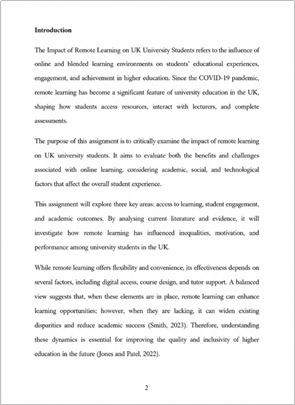
The introduction explains the purpose and guides the reader without giving every detail.
A useful introduction normally includes:
- Brief background to the topic
- The main question or purpose
- Important terms that need definition
- The scope of the discussion
- A short guide to the sections ahead
In the case of a research-based task, you can use aims, objectives, or a thesis statement as well. Concentrate on your research question in the introduction.
Main Body
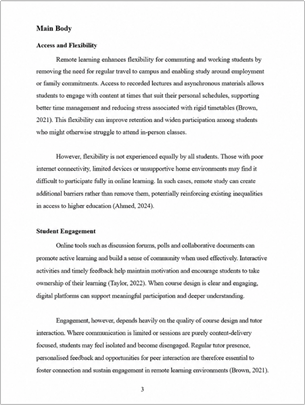
The main body consists of arguments, supporting evidence, illustrations, and critical analysis. Divide it into sections, in case of a lengthy task or if the brief requires headings.
Every paragraph must cover one point only. You can use the PEEL technique for that:
- A point introduces the paragraph idea
- Evidence supports the point
- Explanation shows what the evidence means
- Link joins the point to the question or the next paragraph
The evidence might include anything from a book or other scholarly works, statistics, policies, or journal articles. Explain the significance of all quotations or numbers.
Analytical paragraphs will compare opinions, point out limitations and explain why one perspective makes more sense than another. This is how you take your writing toward critical analysis.
Conclusion
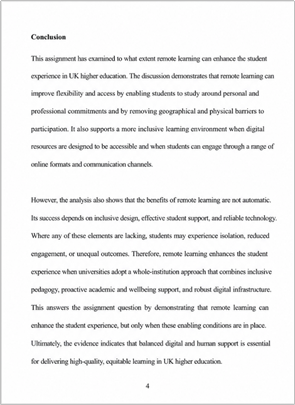
The conclusion will state a straightforward answer to the assignment question. It will summarise the findings of your essay without repeating the contents of the introduction.
A good conclusion should:
- Restate the purpose in fresh words
- Summarise the main findings
- Explain the overall judgement
- Avoid new evidence or new arguments
Suggestions can be provided in a report if requested by the report brief.
References
Include all references used in the report. Format references according to the style required in your course, which includes Harvard referencing, APA, MLA, or OSCOLA.
A reference list is made up of sources used in the report. A bibliography consists of sources that have been read but not referenced. Most assignments require a reference list only.
Appendix
The information provided in an appendix is useful and important to your work but may be too detailed for inclusion in the main body of your text. These could be questionnaires, tables, interviews, computations, or even more images.
Your appendices should be clearly labelled as Appendix A, Appendix B, and so forth, and you should mention them in your main text.
This structure of an assignment provides a clear pathway to your conclusion.
Step #4 – Use Standard UK Formatting
The exact standard assignment format UK universities use can vary. Always follow your brief first.
Font and Size
Choose a simple font such as Arial, Calibri, or Times New Roman. Text font size could be 11 or 12 points, while heading fonts can be larger and bold.
Try not to use many fonts in your paper. Consistency is preferred over decoration.
Line Spacing
The most common line spacing is 1.5 and double space. This allows for better legibility and space for remarks. References may use single spacing.
Margins
Margins can be standardised to 2.54 cm on each side. In some cases, departments request an enlarged left margin for printing purposes.
Page Numbers
Insert page numbers in the header or footer. In most instances, the cover page will serve as the first page without a number indication.
Headings
Keep your headings well structured. Headings in the primary sections should have a similar style, while those in secondary sections should use a different style. Avoid changing heading sizes and boldness randomly.
The automatic features for creating headings in Microsoft Word and Google Docs assist in maintaining consistency in sections, as well as generating the content page automatically.
Tables and Figures
Number all tables and figures in the sequence in which they appear on the paper. Name all tables and figures. Refer to each table and figure in the main text to provide context.
Add the source below for copied or adapted material. Keep labels readable when the file is converted to PDF.
File Setup
Make sure you create backups of your work at all times. Use the file name and format specified by the requirements. Most universities require a Word document or a PDF to be uploaded via Blackboard, Moodle, or Canvas LMS.
After saving the final version of your work, open it, and make sure that page breaks, tables, headings, and citations haven’t been changed. Only then upload it and review the Turnitin receipt or submission confirmation.
This strategy allows creating an elegant written assignment format without making the document look overdesigned.
Step #5 – Structure Different Assignment Types
The correct order depends on the task. The following formats cover the most common university assignments.
Essay Format
A university assignment essay format usually includes an introduction, connected body paragraphs, a conclusion, and references. Headings may be allowed, but many traditional essays use continuous paragraphs.
The introduction presents the central argument. Each body paragraph develops one part of that argument. The conclusion gives the final answer.
Report Format
A report uses clear headings and may include:
- Title page
- Executive summary
- Contents page
- Introduction
- Method or approach
- Findings
- Discussion
- Recommendations
- Conclusion
- References
- Appendices
Use only the sections requested in the brief.
Case Study Format
A case study applies ideas or theories to a person, organisation, event, or problem. It may include background, analysis, options, and recommendations.
Keep the description brief enough to leave space for analysis. Marks usually come from applying knowledge, not retelling the case.
Reflective Assignment Format
A reflective assignment examines an experience and what you learned from it. Reflective writing can use the first person when permitted.
A common order is experience, feelings, evaluation, analysis, learning, and future action. Some courses require a model such as Gibbs or Rolfe.
Literature Review Format
A literature review organises published research by themes, debates, methods, or time periods. It should compare sources rather than describe one source after another.
Include an introduction, themed discussion, gaps in the evidence, and a final summary.
Group Work
A group assignment format depends on whether the class submits one shared document or separate sections. A typical group project includes a shared introduction, agreed sections, one conclusion, and one reference list.
Use the same font, heading levels, citation style, and tone throughout. One person should complete the final formatting check so the work reads as one document.
Presentation Assignment Format
A presentation assignment needs a title slide, clear content slides, a final summary, and references. Keep slide text brief and place detailed explanations in speaker notes when required.
The format for writing assignment work must always match the purpose of the task, rather than forcing every task into an essay model.
Step #6 – Keep Academic Writing Clear
A strong academic assignment structure must continue inside every paragraph. Good page order cannot fix paragraphs that lack focus or connection.
Begin each paragraph with a topic sentence. This tells the reader what the paragraph will discuss. Follow it with evidence, explanation, and a link to the main question.
Use transitions to show relationships between ideas. Words such as “however”, “therefore”, “similarly”, and “in contrast” can help. Use them only when the relationship is real.
Maintain an academic tone by using clear, measured language. Avoid slang, unsupported claims, and emotional wording.
Show critical thinking by asking:
- How reliable is this source?
- Does another study disagree?
- What limits the evidence?
- Does the theory fit this situation?
- What conclusion is justified?
Add a citation whenever you use another person’s idea, words, data, or model. Use a proper In-text citation and include the full source details at the end.
When learning how to structure a university assignment, remember that flow depends on meaning. Each sentence should support the paragraph, and each paragraph should support the overall answer.
Step #7 – Review Before Submission
Proofreading should cover meaning and presentation. Do not limit the final check to spelling.
Read the assignment once for argument and once for formatting. During the first read, check whether every section answers the question. During the second, check headings, spacing, page numbers, tables, and references.
Tools such as Grammarly and Microsoft Editor can find grammar and spelling problems. Review each suggestion before accepting it.
Use Turnitin in line with university rules. A similarity score is not a plagiarism decision. Check whether matches come from quotations, references, templates, or weak paraphrasing.
Before uploading, confirm:
- The word count is within the allowed range
- Every source has a matching citation
- The reference style is consistent
- The file opens correctly
- The assignment follows the required university assignment format
Assignment Structure Example
The images below show a complete student assignment sample format as it may appear in a properly formatted university document. Use this visual example as a guide only. Your own assignment must follow the instructions in your coursework brief, module handbook, and marking rubric.
Front Page Example
Introduction Example
Main Body Example
Conclusion Example
Reference Example
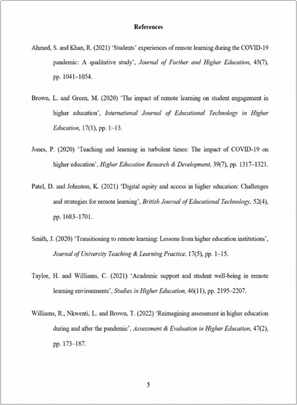
Editable Assignment Structure Template
Use this simple format for writing assignment work as a starting point:
- Cover page
- Contents page when required
- Introduction
- Main body section one
- Main body section two
- Main body section three
- Conclusion
- References
- Appendices when required
Under each section, note its purpose, evidence, examples, and planned sources.
You can create the template in Microsoft Word or Google Docs. Apply heading styles from the start. Add an automatic contents page for long work. Save a blank copy before adding your assignment content.
Reference tools such as Zotero, Mendeley, and EndNote can help store source details and generate citations. Check every output against university guidance because automatic references can contain errors.
The best assignment structure format for students is editable. It should support the brief, not force every assignment into the same pattern.
Common Structure Mistakes
| Starting Without a Plan | Writing immediately can cause repetition and missing evidence. Build the outline first. |
| Writing a Vague Introduction | A weak introduction gives a broad background but does not state the purpose, scope, or argument. |
| Describing Instead of Analysing | Description tells the reader what happened. Analysis explains why it matters, how evidence connects, and what judgment can be made. |
| Using Unconnected Paragraphs | Relevant paragraphs can still feel disconnected. Use topic sentences and links. |
| Adding New Ideas in the Conclusion | The conclusion should answer the question using points already discussed. |
| Using the Wrong Reference Style | Mixing APA Style, MLA Style, OSCOLA, and Harvard referencing creates inconsistency. Follow one required style. |
| Ignoring Academic Integrity | Poor paraphrasing, missing sources, and copied text can create academic integrity concerns. Correct citation practice reduces the risk of plagiarism. |
| Formatting at the Last Minute | Late formatting can break contents pages and move tables. Apply styles early. |
Final Submission Checklist
Use this checklist before you submit:
- Cover page includes the required details
- Contents page is updated
- Headings follow a clear order
- Font, margins, and spacing match the brief
- Page numbers appear correctly
- Tables and figures have titles and sources
- Introduction states the purpose
- Main body answers the question
- Conclusion gives a clear final answer
- Every citation appears in the references
- Word count is within the allowed range
- Appendices are labelled and mentioned in the text
- File name and type are correct
- Upload is complete on Blackboard, Moodle, or Canvas LMS
- Submission receipt has been saved
Using the Assignment Structure Format
A clear assignment structure format helps you present good ideas in a way that tutors can follow and assess. Start with the brief, plan your sections, choose the right format, and check every requirement before submission.
The best written assignment format is not the most decorative one. It is the one that meets the task, supports your argument, uses evidence clearly, and follows your university guidance.
Use this guide as a practical starting point, then compare it with your module handbook, marking criteria, and tutor instructions. That final check will help you produce accurate, readable, and well-organised work.
Frequently Asked Questions
1. How do you structure an assignment?
Start with the brief and identify the task type, learning outcomes, and marking criteria. Plan an introduction, a logical main body, and a conclusion. Add references and appendices when required. This is the basic structure of an assignment for most academic tasks.
2. Which format should assignment writing follow?
The format of assignment writing includes the order of sections and the way the document looks. It covers headings, font, spacing, margins, page numbers, citations, references, tables, and figures.
3. What is the standard assignment format in UK universities?
The standard assignment format UK departments commonly use includes a cover page, introduction, main body, conclusion, and references. Long reports may also need a contents page, executive summary, recommendations, and appendices.
4. Do all universities use the same assignment structure?
No. Each university, school, module, and task may set different rules. Check the brief, module handbook, student handbook, and guidance from your module tutor.
5. Should assignments include a contents page?
Long reports, projects, and dissertations usually need one. Short essays often do not. The assignment content page format should use clear headings and accurate page numbers when included.
6. What font should UK university assignments use?
Arial, Calibri, and Times New Roman are common choices. Body text is often 11 or 12 points. Follow the font stated in your brief because local rules may differ.
7. What is the best assignment structure format for university essays?
A strong university assignment essay format includes a focused introduction, connected analytical paragraphs, a direct conclusion, and a reference list. The body should develop one central argument rather than present separate facts.
8. How should assignment sections be arranged?
Look at the command word, learning outcomes, and mark allocation. Give more space to sections carrying more marks. This helps you decide how to structure assignment content around what is being assessed.
9. How should group work be organised?
A clear group assignment format uses one agreed outline, consistent headings, one referencing style, and a final editing check. Team members should agree on responsibilities early and combine sections before the deadline.
10. Can I find assignment structure templates on writing platforms?
Yes. Many university study portals and academic writing websites offer templates. Choose one that matches your task and update it using the rules in your module documents. A general template should never replace specific tutor instructions.
11. Where can I find templates for higher education assignments?
Check your university skills centre, library pages, Blackboard, Moodle, Canvas LMS, or module resources. You can also build your own reusable template in Word or Docs using the assignment structure format explained in this guide.
12. What should international students check before submitting?
International students should check British spelling, required referencing, command words, academic tone, and local formatting rules. They should also confirm whether first-person language is allowed and whether anonymous marking is used.